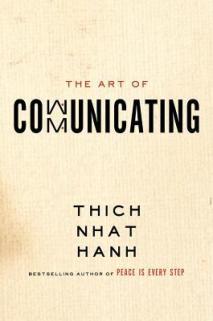
 As a school administrator my summer “break” has already come to a close. This week alone started with three day-long meetings with other district leaders, planning and strategizing for the upcoming school year. However, my summer reading goals continue on, and I have just completed book number 4: The Art of Communicating, by Thich Nhat Hanh. The timeliness of reading this book was perfect for me as I begin the school year with all it’s craziness and bustle, and the impending onslaught of communication.
For those who may be unfamiliar with Thich Nhat Hanh, he is a Zen Master who is an influential promoter of mindfulness and a peace activist. He has written extensively on meditation and mindfulness practices, and has built one of the largest communities of Buddhist monks in the world, Plum village.
My own introduction to Thich Nhat Hanh came about 18 years ago. After my undergraduate studies, and prior to actually going into the teaching field, I spent two years studying for the Roman Catholic Priesthood. Although I decided not to continue with those studies, they have greatly shaped who I am today. During that time, as you can imagine, I spent a lot of time in prayer and meditation. As you would expect, my time was mostly focused around Christian spirituality, but an introduction to the work of Thomas Merton led me to reading some works by Nhat Hanh as well.
In education right now there is a movement that is focused on using Social and Emotional Learning (SEL) in classrooms to help students improve academic outcomes. One aspect that is gaining popularity within this movement is using mindfulness in the classroom. Over the last year I have experienced this shift in education in some interesting places. Last summer our school’s superintendent brought in the director of a local Yoga studio to lead the district administrative team in some guided meditation. This past spring at a meeting of the NYS Board of Regents where I presented on the development of new arts requirements for HS Graduation, the meeting started with a presentation on mindfulness work in classrooms in upstate NY. It heartens me to see our educational institutions coming to understand the vital importance of mindfulness in our lives, and the lives of our students.
With this confluence of mindfulness around me in my professional life, and the role prayer and meditation has had in my personal life, when my sister, Sarah, showed me the book she was reading this summer, I stole it from her and read it first!
The Art of Communication is not focused on the education world, but on communication in our everyday lives. This is the beauty and the strength of Thich Nhat Hahn’s teachings. He consistently shows how mindfulness practices can seamlessly integrate into the everyday activities of our lives. The book shows how true communication starts with understanding and loving oneself and the person with whom you are communicating.
Another strength of Nhat Hahn’s is understanding the current context of our lives, and exposing real truths that are timeless. For example, throughout the books he references our obsession with phones and the internet. He places these things in the right perspective and brings the reader back to what is true and of significance, the present moment.
This book is an easy read, but I recommend it is read slowly. Take time to try out some techniques as they are mentioned in the book. Above all else, ensure that you breathe, and that you remain present and in the moment.
Select quotes:
“We tend to think of nourishment only as what we take in through our mouths, but what we consume with our eyes, our ears, our noses, our tongues, and our bodies is also food. The conversations going on around us, and those we participate in, are also food. Are we consuming and creating the kind of food that is healthy for us and helps us grow? When we say something that nourishes us and uplifts the people around us, we are feeding love and compassion. When we speak and act in a way that causes tension and anger, we are nourishing violence and suffering.”
“Once you can communicate with yourself, you’ll be able to communicate outwardly with more clarity. The way in is the way out.”
“Home is the place where loneliness disappears. When we’re home, we feel warm, comfortable, safe, fulfilled.”
“When we say something that nourishes us and uplifts the people around us, we are feeding love and compassion. When we speak and act in a way that causes tension and anger, we are nourishing violence and suffering.”
“Speech:
1. Tell the truth. Don’t lie or turn the truth upside down.
2. Don’t exaggerate.
3. Be consistent. This means no double-talk: speaking about something in one way to one person and in an opposite way to another for selfish or manipulative reasons.”
 Bradley Morrison
One thought on “Mindfulness in communication”